
Security - Keymate Blog
Category: Security
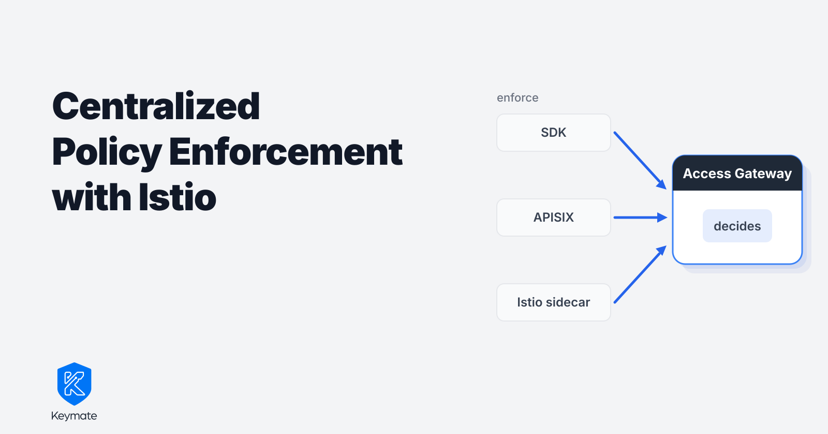
Centralized Policy Enforcement with Istio
Istio can enforce an authorization decision at the sidecar. It should not be the place where that decision is made. Here is how a mesh enforcement point hands the decision to one central service, and what fails when the two stop agreeing.Buket Çoban
October 2026

Fine-Grained Authorization for AI Agents: How It Works in Production
How Keymate enforces fine-grained authorization for AI agents: declarative policies, a centralized engine, and consistent design-time/runtime enforcement.Hüseyin Akdoğan
June 2026

Why AI Agents Need Fine-Grained Authorization
Authentication tells us who the agent is. The harder question is what data it can reach, under what conditions, and on whose behalf. The April 2026 PocketOS incident, in which an autonomous coding agent deleted a production database in nine seconds, showed what happens when no one is answering it.Hüseyin Akdoğan
May 2026

AI Agent Authorization: From Java Day Demo to Open Source Toolkit
At Java Day Istanbul 2026, we asked one question: once an AI agent has a valid token, who decides what data it can reach? This post recaps what we showed on stage, what we open-sourced afterwards, and how the deeper blog series picks up the thread.Hüseyin Akdoğan
May 2026

Beyond the Default Image: Hardening Keycloak for Enterprise Production
The default Keycloak image is a strong baseline, not a hardened production runtime. Here is how we rebuilt it on Wolfi OS, with three-tier CVE management, non-root execution, and a Quarkus-optimized runtime.Ali Tuğrul Pınar
April 2026

Beyond Bearer Tokens: Implementing DPoP for Modern Enterprise Identity
Bearer tokens are like cash: anyone who holds them can spend them. DPoP (RFC 9449) binds tokens to cryptographic keys so stolen tokens become useless. Here is how we implemented it.Eren Kan
April 2026